

Moral decision-making
Governance can be recognised as a moral undertaking, especially when characterised as ‘doing the right things in the right way’.
Ethical (or moral) decision-making involves use of a ‘moral compass’, guided by agreed values, to make decisions which are both legally and ethically sound. The quadrant chart below summarises the combinations facing non-profit directors when they are balancing conformance and performance considerations.

Moral (ethical) culture
‘Organisational culture’ is also recognised as a governance responsibility, and this extends the moral dimension of the board’s work beyond decision-making to promoting and monitoring the desired moral climate for those working on behalf of the organisation.
One moral compass model offered to assist directors and management to create more sustainable enterprises, is summarised in the header image above (based on one devised by Marco Grasso and J. David Tàbara, Towards a Moral Compass to Guide Sustainability Transformations in a High-End Climate Change World, Sustainability 2019, 11, 2971; doi:10.3390/su11102971). Unlike some compasses, which distinguish between right (true North) and wrong options, this one outlines three sets of considerations relating to values, standards, and principles, all of which are recommended as decision-making aids or factors.
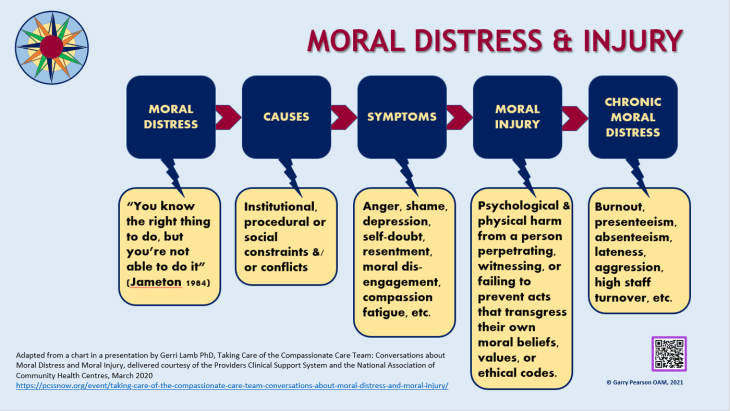
Moral distress has been defined as occurring “When one knows the right thing to do, but institutional constraints make it nearly impossible to pursue the right course of action” (Jameton 1984). This condition is different from a moral dilemma where two or more equally valid actions are known but a choice must be made between them. It also differs from moral ambiguity or confusion, where the right course of action is not known. Part 2 in this series of posts will offer further perspectives on these distinctions.
Doing the right things the wrong way
Focussing on ‘adding value’ and ‘productivity’ as boards are required to do, can sometimes mean that employees and volunteers are placed under moral pressure. Where this occurs, it could be thought of as ‘doing the right things the wrong way’, and so directors and managers need to be alert to this risk, and use appropriate preventive controls.
There can be a mismatch between what staff or volunteers believe is right and what they are being asked to do – or not do. This may lead to moral distress and/or injury, as outlined in the continuum chart below (adapted from a chart in a presentation by Gerri Lamb PhD, Taking Care of the Compassionate Care Team: Conversations about Moral Distress and Moral Injury, delivered courtesy of the Providers Clinical Support System and the National Association of Community Health Centres, March 2020).
Your organisation’s risk inventory is likely to include a health and safety commitment, and will doubtless have assessed specific risks to the public, staff, and volunteers from the activities you undertake. You may not have considered the risk of moral distress or injury to the psychological health of your personnel however, and so the chart below, adapted from one devised by Celia Moore and Francesca Gino (2013), outlines facilitators, aggravators, and some of the psychological consequences of neglecting the moral dimension of work within an organisation.

Moral (ethical) governance requires attention to the elements of the organisational climate and culture which support and enhance the meaningful engagement of staff and volunteers. This will be the focus of Part 2 in this series of posts (to follow).
See also:
Moore, C. and Gino, F., Ethically adrift: How others pull our moral compass from true North, and how we can fix it. Research in Organisational Behaviour 33 (2013) 53-77


I work at a school whose leadership operates in a manner that creates the most extreme symptoms of moral distress from a variety of behaviors, actions, personalities, etc. What astounded me while reading this was that each and every one of the most immoral and inefficient ends of a spectrum aligned with our leaders qualities. The indicators are seen in the atrocious morale and high turnover during the course of the last 5 years. I guess I’m wondering if and how one can organize or influence positive changes as a single individual with close relationships with my colleagues? Most simply say to leave and go elsewhere. However, I guess I feel that if I give up on the students I genuinely love and my colleagues who I have strong relationships with and so doing so seems hypocritical and I ask myself how can I simply leave and give up on a place I believe has the capacity to be great? Sorry for a post that likely won’t ever reach anyone. I simply feel defeated, powerless, and yet everything that inhibits our collective success seems so incredibly obvious and so easily attainable given that honesty, organization, collaboration, and setting shared goals are effectively the qualities our leadership not only lacks but seems to almost purposely contradict or negate.
Hi Matthew
Your query deserves a more considered reply than a short grab online. I have some thoughts I’d like to send to you, but would prefer to do that via email – if you would be comfortable sending me your private email address (to pearsongl@gmail.com). In the meantime, I am also drafting a new blog post triggered by your query – currently titled ‘What can one person do?’ – but without naming you or referring to the details of your situation.
Best wishes, Garry